Spray, Roll or Brush: How Painting Contractors Decide
Posted 10/09/2026
Ask three painters how they will apply the coating and you can get three different answers for the same house, all of them defensible. Ask why, and the good ones will give you a reason rooted in the substrate and the product rather than a preference. The tool is not a style choice. Each of the three puts a different amount of material on the wall, bonds it differently, and costs a different amount of labour, and the right one changes from surface to surface within a single job.
Anyone arranging house painting in long beach or anywhere with a mix of stucco, wood trim and metal on the same elevation is buying all three methods on the same contract, whether or not the estimate says so.
What each tool actually does to the film
The measurement that matters is film thickness, expressed in mils, meaning thousandths of an inch. Every product has a specified wet film thickness which, after the water or solvent leaves, yields a specified dry film thickness. The warranty and the expected lifespan are both calculated from that number. Get the film too thin and the coating fails early regardless of quality. Too thick and it can crack, sag or fail to cure properly through its depth.
A brush lays down the thickest, most consistent film of the three, and it works material into the surface mechanically. That mechanical action matters on chalky, porous or previously coated surfaces, where the bond depends on the coating being physically driven into the profile rather than laid over it.
A roller lays down a good film and covers area quickly. Nap length controls how much material it holds and how well it reaches into texture. A short nap on heavy stucco will coat the peaks and leave the valleys thin, which is the most common roller error.
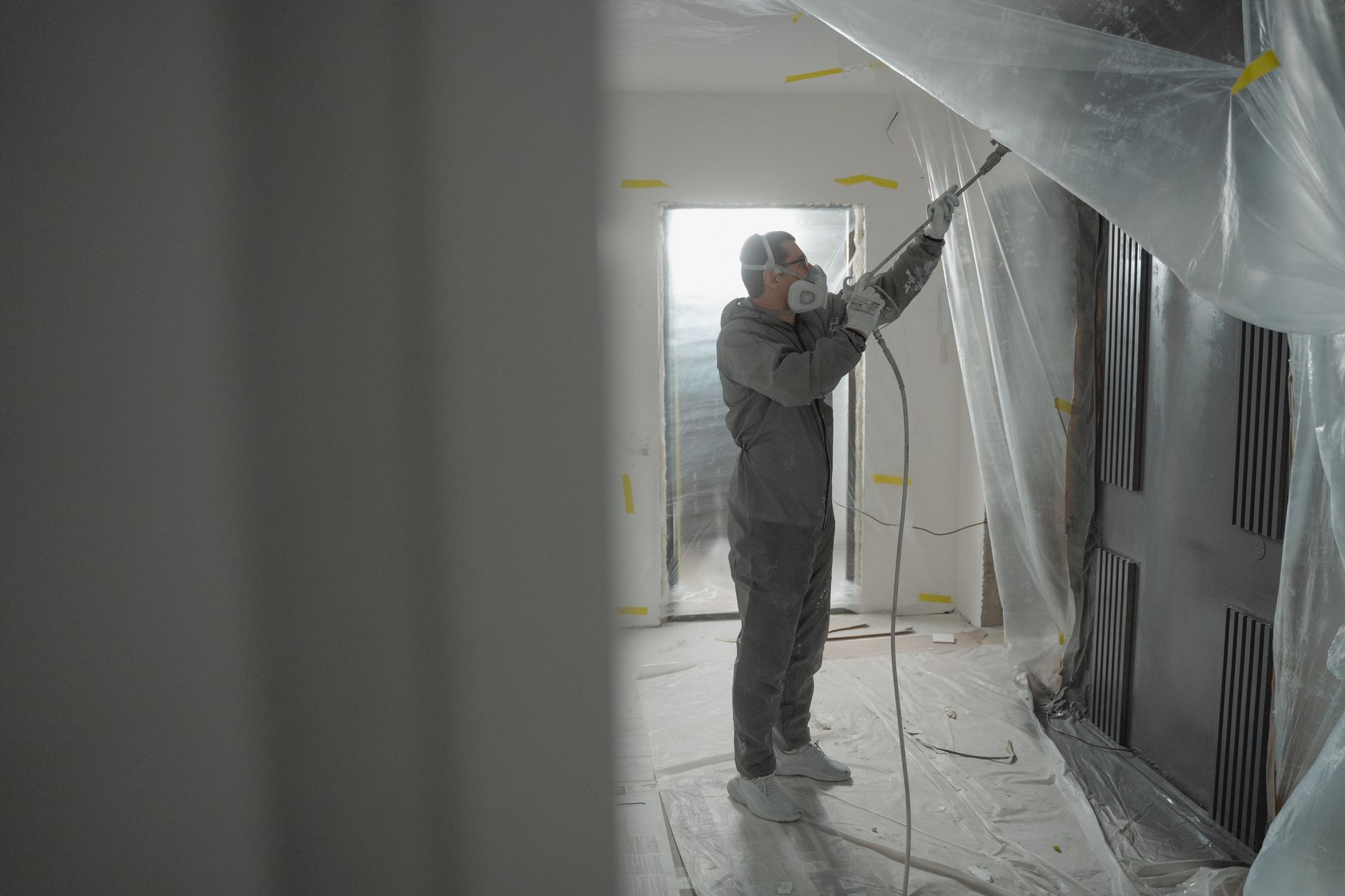
A sprayer atomises the material and deposits it as droplets that flow together. It covers area extremely fast and it reaches surfaces a brush cannot, but it deposits material on the surface rather than into it, and the film thickness depends entirely on the operator’s speed, distance and overlap discipline.
Spraying is faster, not cheaper, and not by itself sufficient
The persistent homeowner belief is that spraying is the cheap way and brushing is the quality way. Neither half is reliably true.
Spraying is dramatically faster on open area, and on a large stucco house it is the only sensible approach to the body. But the time saved on application is partly spent on masking. Everything not being coated has to be covered: windows, fixtures, hardscape, plants, roof edges, neighbouring property. On a house with a lot of glazing and tight setbacks, masking can take longer than the coating.
Transfer efficiency is the other half. A conventional airless sprayer puts a meaningful share of the material into the air rather than onto the wall, so material consumption rises. On a large simple surface the labour saving still wins comfortably. On a small fussy one it does not.
The more important point is that spraying alone is usually not the finished technique. On any porous or textured substrate the correct method is spray and back roll, meaning a second person follows immediately behind the sprayer with a roller and works the wet material into the surface. Spraying puts the material on quickly and evenly. Back rolling creates the bond and pushes coating into the valleys of the texture.
A crew spraying stucco without back rolling is producing a job that will look excellent for a year and then show uneven sheen and early failure in raking light. It is the single most common corner cut on exterior work and it is invisible at the walkthrough.
Where the brush is not optional
Cutting in. Every line where one colour meets another, every edge against glass, every junction between body and trim, is brush work. A straight cut line is the thing a finished job is judged on at close range, and there is no tool that produces it faster.
Trim, fascia and doors. Trim enamels are formulated to level out under a brush, and the surfaces are narrow enough that masking for spray costs more than brushing. The exception is when there is a very large run of identical trim and the crew can mask efficiently, in which case spraying trim is legitimate and produces a smoother finish.
Chalked and weathered surfaces. Where the old coating has broken down to loose pigment, the mechanical working of a brush gets the first coat into sound material in a way spraying cannot.
Detail and profile. Carved brackets, corbels, mouldings with deep relief, window muntins. A sprayer floods the recesses and starves the arrises. A brush controls where the material goes.
Touch up and the punch list. Always brush, and always with the same product and sheen, because a touch up sprayed over a rolled surface will show as a patch of different texture forever.
Where the roller is the right answer
Interior walls and ceilings, almost universally, because masking an occupied room for spray is expensive and the finish gain on flat drywall is small.
Exterior body on a house where spraying is impractical: tight lot lines, a neighbour’s car in an unavoidable position, a windy site, or an association that prohibits spraying.
Any surface where overspray risk is high and the area is moderate.
And behind the sprayer, on every porous substrate, as described above.
Where spraying is clearly correct
Large uninterrupted stucco elevations. Nothing else is remotely competitive on time.
Soffits, eaves and rafter tails, where brushing overhead is slow and physically punishing and the finish is worse.
Metal security screens, wrought iron, railings and lattice, where brush and roller both struggle to reach and leave runs.
Cabinet doors and any factory smooth finish where the goal is a surface with no brush marks at all. On cabinetry, spraying is not a convenience, it is the only way to achieve the expected finish, and a sprayed cabinet job should be done with the doors off and laid flat.
Fences, especially rough sawn timber, where spray and back roll or spray and back brush covers ground quickly and gets into the grain.
The specific risks of each, stated plainly
Spray risks are overspray, thin film from moving too fast, heavy film and sags from moving too slowly, dry spray in hot or windy conditions where droplets skin over before they land, and tiger striping from poor overlap discipline. Every one of those is an operator variable rather than a tool defect.
Roller risks are stippled texture where a smooth finish was wanted, lap marks when the wet edge is lost on a hot day, and thin coverage in texture from a nap that is too short.
Brush risks are visible brush marks in a product that does not level well, slow progress leading to lost wet edges on large areas, and fatigue driven inconsistency late in a long day.
What to ask, and what a good answer sounds like
Ask, surface by surface, which method is planned. A crew that says spray for the body with back rolling, brush for the trim and cut lines, spray for the eaves and the metal has thought about it. A crew that says spray, for everything, has not.
Ask specifically whether the body will be back rolled. This is the highest value question on the entire list and the answer is a strong quality indicator.
Ask what the masking plan is, and specifically what protects the neighbouring property, the roof and the planting.
Ask about the spread rate, meaning how much area one gallon is expected to cover on your substrate. Compare it against the manufacturer’s stated figure. A crew planning to stretch material well beyond the rated coverage is planning a thin film, and a thin film is a short life.
Ask what happens on a windy day. The right answer is that spraying stops.
The thing that actually determines quality
None of these tools is better than the others. The variables that decide whether the coating lasts are film thickness, adhesion and the conditions during cure, and all three of those can be achieved or destroyed with any of the three tools in any combination.
What distinguishes a good job is that the method was chosen per surface for a reason, that the material went on at the rate the manufacturer specified, and that somebody worked it into the wall rather than simply covering it. Everything else is preference, and preference is fine as long as it is not standing in for a decision nobody made.
Need help in Long Beach?
Call (562) 962-6442